 US Site
Why outdoor IR heating is replacing gas patio heaters across UK hospitality

VICTORY
Picture a busy pub garden on a drizzly Thursday in October. Half the tables are empty because the gas mushroom heaters have run out and the spare cylinders are in a lock-up nobody can find the key to (sound familiar?).
It's a scenario played out in thousands of UK hospitality venues every year, and it's becoming less and less acceptable to the operators who run them. Energy bills are up. Gas cylinder costs are unpredictable. Local authorities are tightening restrictions on open-flame heating in outdoor spaces. And customers are increasingly choosing where to sit based on whether they'll actually be warm.
There's a reason outdoor infrared electric heaters are appearing above the bar terraces, alfresco dining areas and rooftop spaces of venues across the UK.
The problem with gas patio heaters
Gas patio heaters—the classic mushroom or pyramid style—have been used across UK hospitality outdoor spaces for decades. They're familiar, widely available and for a long time they were the only realistic option. But the economics and logistics have shifted.
Running costs are volatile and hard to control. Commercial propane prices have fluctuated significantly in recent years, and cylinder-dependent systems mean you're at the mercy of both the market and your delivery schedule. You can't turn a gas heater down to 50% and expect a proportional saving, you get full output or nothing.
They heat the air, not the people. This is the fundamental physics problem with convection-based heating outdoors. Hot air rises. In an open or semi-open outdoor space, gas heaters warm the column of air directly above them, which then drifts away the moment there's any movement.
They require ongoing maintenance and compliance. Gas appliances in commercial settings require periodic inspection, PAT testing and safe storage of cylinders. That's administrative overhead, storage space and liability that many operators would rather not carry.
They produce CO₂ and NOₓ emissions. For venues working towards sustainability targets or reporting under ESG frameworks, every gas heater on the terrace is a problem to explain.
How infrared electric heating works
Infrared heating doesn't warm the air. It warms objects and people directly (the same way the sun does).
When you stand in sunlight on a cold day, you feel warm even though the ambient temperature hasn't changed. That's infrared radiation at work. Industrial and commercial IR heating systems replicate this effect using electric infrared lamps, typically in the medium-wave or short-wave spectrum, depending on the application.
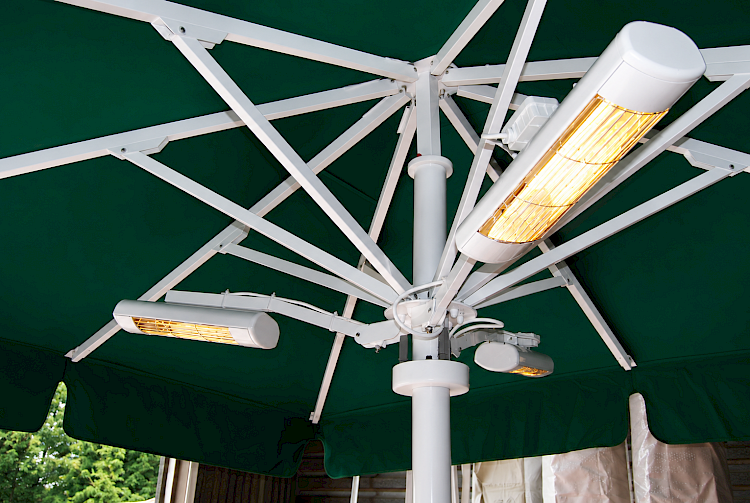
In an outdoor hospitality setting, ceiling or wall-mounted IR heaters direct that warmth precisely where it's needed—at table height, in the zone where your customers are sitting. Not up into the canopy. Not across the street. At the people.
The practical results are significant:
- Instant-on, instant-off. No warm-up time, no cool-down period. Heat exactly when and where you need it.
- Precise zone control. Run one heater over a single table rather than warming an entire section nobody's using.
- No flame, no cylinder, no combustion. No gas safety inspections, no delivery scheduling, no cylinder storage.
- Energy efficiency. Because you're heating people rather than air, the energy that goes in is doing useful work. Zoned control means you're not running heaters over empty tables.
- Weather-resistant options available. Rated for outdoor installation, suitable for covered terraces, pergolas and open canopies.
The real-world commercial case
Let's look at this from an operator's perspective, because that's where the decision gets made.
Capital cost vs running cost. Electric IR heaters have a higher upfront cost than a gas mushroom heater. But the running cost comparison over 2–3 seasons tells a different story, particularly when you factor in cylinder costs, maintenance, and the administrative overhead of gas compliance. Many operators find the payback period surprisingly short.
Reliability. An electric IR heater doesn't run out mid-service on a Saturday night. There are no deliveries to schedule, no cylinders to check, no flame outages in the wind. For a busy venue, that operational reliability is worth a significant premium on its own.
Customer experience. Directional warmth at table height keeps customers comfortable in a way that ambient gas heating rarely achieves outdoors. Comfortable customers stay longer. Customers who stay longer spend more.
Sustainability credentials. If your venue is working towards net zero commitments, has made public pledges around Scope 1 and 2 emissions, or simply wants to talk honestly about sustainability to its customers, replacing gas heaters with electric IR is one of the more straightforward steps available. Pair it with a renewable energy tariff and the story is even cleaner.
Planning and licensing. Some local authorities and listed building consent conditions already restrict or prohibit open-flame heating in outdoor spaces. Electric IR heaters carry none of those restrictions.
Thinking about making the switch to infrared heating? Let's talk about your space.
We work with hospitality operators across the UK to specify the right infrared heating system for their outdoor areas, whether that's a covered terrace, an open rooftop, a pergola or a courtyard garden. We'll help you work out what you need, what it'll cost, and what the likely running cost saving looks like.
Speak to one of our technical team
What to look for when specifying outdoor IR heating
Wattage and coverage. As a rough guide, you need around 1kW of IR heating capacity per square metre of outdoor space in a typical UK climate. For covered spaces with some wind protection, you may need less. For fully open spaces on exposed sites, more.
IP rating. For outdoor installation, you need a heater rated at least IP44 (splash-proof). For installations directly exposed to rain, open canopies, for example, IP65 is more appropriate.
Mounting options. Ceiling-mounted heaters are generally more efficient (the heat goes down, not up) and more aesthetically unobtrusive. Wall-mounted is appropriate where ceiling height is limited. Free-standing is an option for flexibility, but fixed installation almost always delivers better performance.
Control system. The real efficiency gains from IR heating come from intelligent control such as thermostats, timers, zone control and ideally remote or app-based management. A good control system can cut energy consumption significantly compared to manual switching.
Lamp life and replacement costs. Lamp life in commercial IR heating systems typically ranges from 5,000 to 20,000+ hours depending on the technology. Cheap imported heaters often use low-quality lamps that fail early and are difficult to source replacements for.
Dimming capability. Many mid-wave and short-wave IR heaters can be dimmed which is useful for mild evenings where full output isn't needed, and contributes to energy efficiency.
Infrared heating in UK hospitality: what venues are getting right
The venues getting the most out of their outdoor IR heating tend to share a few characteristics:
They've thought about zones rather than blanket coverage. Rather than installing heaters to cover every square metre of outdoor space, they've identified the highest-value seating areas—the spots customers actually want to sit—and concentrated warmth there.
They've invested in control. Timer and zone control pays for itself quickly. Running outdoor heating at full output from 3pm to 11pm every day burns unnecessary energy; running it on a timer that matches your outdoor service hours doesn't.
They've chosen fixed installation over free-standing. Ceiling or wall-mounted heaters look better, perform better and don't get moved around, knocked over or borrowed by kitchen staff.
They've thought about the visual impact of modern commercial IR heaters are genuinely slim, minimal, unobtrusive. The days of the clunky orange-glowing bar heater are largely behind us, and specifying the right product for the aesthetic of your space is worth the extra consideration.
The UK's regulatory direction of phased fossil fuel removal
The UK government's net zero commitments and the Future Homes Standard are both driving the phased removal of fossil fuels from buildings. While the focus has been on domestic heating, the direction of travel for commercial premises is the same. The Clean Heat Market Mechanism and related policy frameworks are making gas heating progressively more expensive and more restricted.
For hospitality operators, getting ahead of this curve, rather than being forced into a switch under pressure, makes commercial sense. The capital investment required now is almost certainly lower than it will be when the switch becomes mandatory, and the operational benefits start accruing from day one.
We supply and specify outdoor infrared heating for UK hospitality
We're a UK manufacturer and supplier of both infrared and ultraviolet technology for commercial and industrial applications, headquartered in Leighton Buzzard and operating across the UK, EU and USA (we can supply globally).
Our infrared heating range includes medium-wave and short-wave systems suitable for outdoor hospitality applications, with IP-rated housings, dimming capability and full compatibility with zone control systems.
Whether you're replacing existing gas heaters across a single venue or specifying a new outdoor space from scratch, we can help you get the specification right.
Contact our team to discuss your outdoor heating project or browse our infrared heating range.
Ready to discuss specific products or a custom solution?