 US Site
IR and UV: The Industries You'd Never Expect to Find Them In
Ask most people where infrared and ultraviolet light show up in manufacturing, and they would offer the obvious answers: UV sterilisation in healthcare, maybe IR heating in industrial ovens.
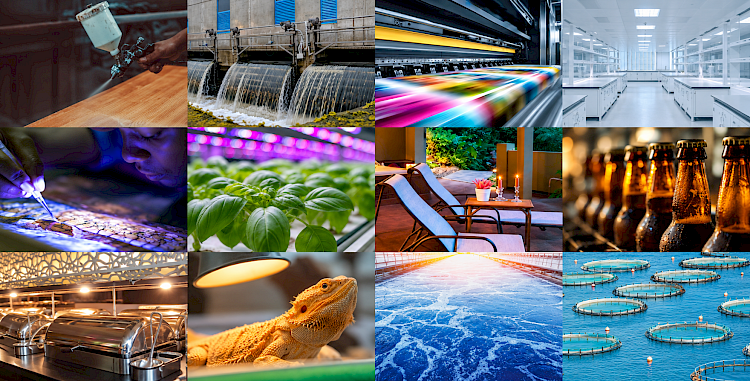
They wouldn't think of the water in a fish farm. Or the label on a beer bottle. Or the DWR finish on a running jacket. Or the conveyor belt in a food packing facility.
But that's exactly where IR and UV technology are already working — quietly, reliably, and in many cases doing something that no other technology does as well.
We work with clients across a wide range of sectors, and one of the things we encounter most often is the gap between what IR and UV technology can do and what the people who need it most know about it.
This article is our attempt to close that gap — a tour through four industries where light-based processing is already essential, often unrecognised, and increasingly the smarter alternative to the chemical or thermal approaches it's replacing.
Textiles: The Invisible Layer in Your Technical Fabric
Take the textile and technical fabric industry, and a very live regulatory story: the PFAS ban.
PFAS — per- and polyfluoroalkyl substances, the so-called 'forever chemicals' — have been the chemistry behind durable water repellent (DWR) finishes on performance fabrics for decades. They are now being phased out under EU and UK regulation, with France and Denmark already enforcing bans on PFAS-containing clothing and waterproofing agents, and the broader EU PFAS restriction making its way through the regulatory process toward a wider deadline.
The challenge for textile finishers isn't just swapping one chemical for another. It's maintaining the performance properties their customers expect — oil repellency, water resistance, durability through washing — using the next generation of PFAS-free chemistries. And that's where the curing process matters as much as the chemistry itself.
Most PFAS-free DWR alternatives are water-borne formulations. Getting a consistent, durable cure on a water-based coating — without heat damage to the substrate — is exactly where infrared drying excels. IR targets the coating and the substrate directly, rather than heating the surrounding air.
Combine that with UV curing to achieve rapid, controlled cross-linking of reactive chemistries, and you have a processing approach that gives textile finishers a credible route through the PFAS transition without sacrificing throughput or quality.
For the textile and technical fabric industry, IR and UV aren't add-ons. They're how the next generation of finishing chemistry gets to work.
Read the full article: The PFAS Ban and Textile Finishing – Why IR and UV Could Be the Answer →
Food Processing: Replacing the Chemical with Light
The food processing industry is one of the most demanding hygiene environments in UK manufacturing, and one where the case for replacing chemicals with UV-C is increasingly hard to ignore.
Chemical sanitisers have always been the primary tool for managing food safety on production lines. Chlorine-based compounds, peracetic acid, quaternary ammonium agents — they are effective, but they carry persistent costs: procurement, handling, residue management, disposal, and an ongoing risk of chemical taint finding its way into product.
UV-C disinfection disrupts the DNA of bacteria, viruses, moulds and fungi, rendering them unable to reproduce — without introducing anything into the environment. No residue, no rinsing, no chemical waste stream. UV treatment can eliminate up to 99.9% of bacteria on food contact surfaces, and it works in real time, integrated into the production line rather than requiring the line to stop.
Applications can include surface disinfection, packaging treatment, process water, juice and beverage treatment, and air treatment through HVAC systems. Each represents a point on the production line where chemical dependency can potentially be reduced and hygiene controls strengthened.
For UK food manufacturers navigating the dual pressure of tighter food safety regulation and rising chemical costs, UV-C is a mature technology already used across a wide range of hygiene and disinfection applications.
Explore Victory's UV-C disinfection solutions →
Aquaculture: Clean Water, Without the Chemistry
Perhaps the sector that surprises people most: fish farming and aquaculture.
UK aquaculture — from Scottish salmon hatcheries to inland trout farms and the growing number of land-based recirculating aquaculture systems (RAS) across England and Wales — depends entirely on water quality.
The fish live in it, grow in it, and are constantly exposed to whatever pathogens it carries. Traditional chemical water treatment manages that risk but creates its own challenges, particularly within intensive or recirculating systems.
UV-C water treatment at 253.7nm — a key germicidal wavelength — inactivates bacteria, viruses and parasites in the water column as it passes through an inline reactor, without adding anything to the water. No residue. No chemistry added to the treatment process.
In RAS facilities in particular, where the same water is recirculated continuously, UV-C can form a core component of the disinfection loop, supporting the biosecurity standards intensive closed-loop production requires.
UV-C treated water can also support hatchery applications, helping manage microbiological risks around juveniles and eggs at vulnerable stages of production.
Victory supplies a wide range of UV-C disinfection and replacement lamps for water treatment applications, including replacements for major UV system manufacturers.
Explore our UV-C water, air and surface disinfection solutions →
Labels and Narrow Web: The Lamp That Runs Your Press
The label and narrow web printing industry is in the middle of a technology transition that is already well underway in UK print.
Mercury arc UV curing has been the standard for narrow web label printing for decades. It works. But it is energy-intensive, generates significant heat and uses mercury-containing lamps that require controlled handling and disposal.
UV-LED curing changes the way UV energy is delivered to the press. With significantly lower heat output, it can support heat-sensitive filmic substrates that can be more challenging under conventional mercury UV.
It also switches on and off instantly, consuming power when curing is required rather than relying on the warm-up and cool-down cycles associated with conventional mercury systems. LED service life can also extend beyond 20,000 hours depending on system design and operating conditions.
For label converters, the potential benefits span energy consumption, substrate versatility, press uptime, maintenance requirements and lamp replacement frequency.
Victory's UV curing systems include dedicated Flexo, Offset and Digital UV LED systems, alongside air-cooled, water-cooled and other UV curing configurations for different production requirements.
Read the full article: Mercury Arc to UV-LED – The Business Case for Narrow Web Label Printers →
Beyond the Four: Where Else Does This Show Up?
These four sectors make a compelling case, but they're not the whole story. IR and UV technology shows up in places that are even less expected.
In horticulture and vertical farming, carefully controlled UV exposure can influence plant development and secondary metabolite production, while IR heating can provide targeted warmth for propagation and controlled growing environments. Both technologies can play a role in crop quality, environmental control and energy efficiency.
You can explore horticulture and vertical farming alongside Victory's other specialist applications in our Light You Never Knew You Needed hub.
In craft brewing and distilleries, UV-C can be used for process water and hygiene applications without introducing chemical residues into the treatment process. For small-batch producers where consistency, microbiological control and product quality are critical, that can be particularly valuable.
Read more about UV-C sterilisation for UK craft breweries and distilleries →
In pharmaceutical cleanrooms, UV-C disinfection can be integrated into wider contamination-control programmes as a complement to established chemical cleaning and disinfection methods. It provides a repeatable, residue-free approach for air and surface treatment where the application and UV dose are correctly designed and validated.
In each case, the pattern is the same: a sector with a real process challenge, an established chemical or thermal approach carrying its own costs and complications, and IR or UV offering another way to improve efficiency, process control or hygiene.
The Bigger Picture
Four main sectors. Three supporting ones. One consistent theme: IR and UV are already doing work that many of the professionals running these operations don't know they're doing — or don't yet know could be done better.
The PFAS transition in textiles, the drive to reduce chemical sanitisers in food production, the push toward lower antibiotic use in aquaculture, and the energy and technology transition taking place in narrow web print — these are real, live industry challenges.
IR and UV aren't theoretical solutions to future problems. They are technologies already being applied to challenges manufacturers and processors are dealing with today.
That's the light you never knew you needed.
Want to find out where IR or UV could fit into your process? Explore The Light You Never Knew You Needed or speak to our team about your application.
sales@victorylighting.co.uk
www.victorylighting.co.uk

VICTORY
Ready to discuss specific products or a custom solution?